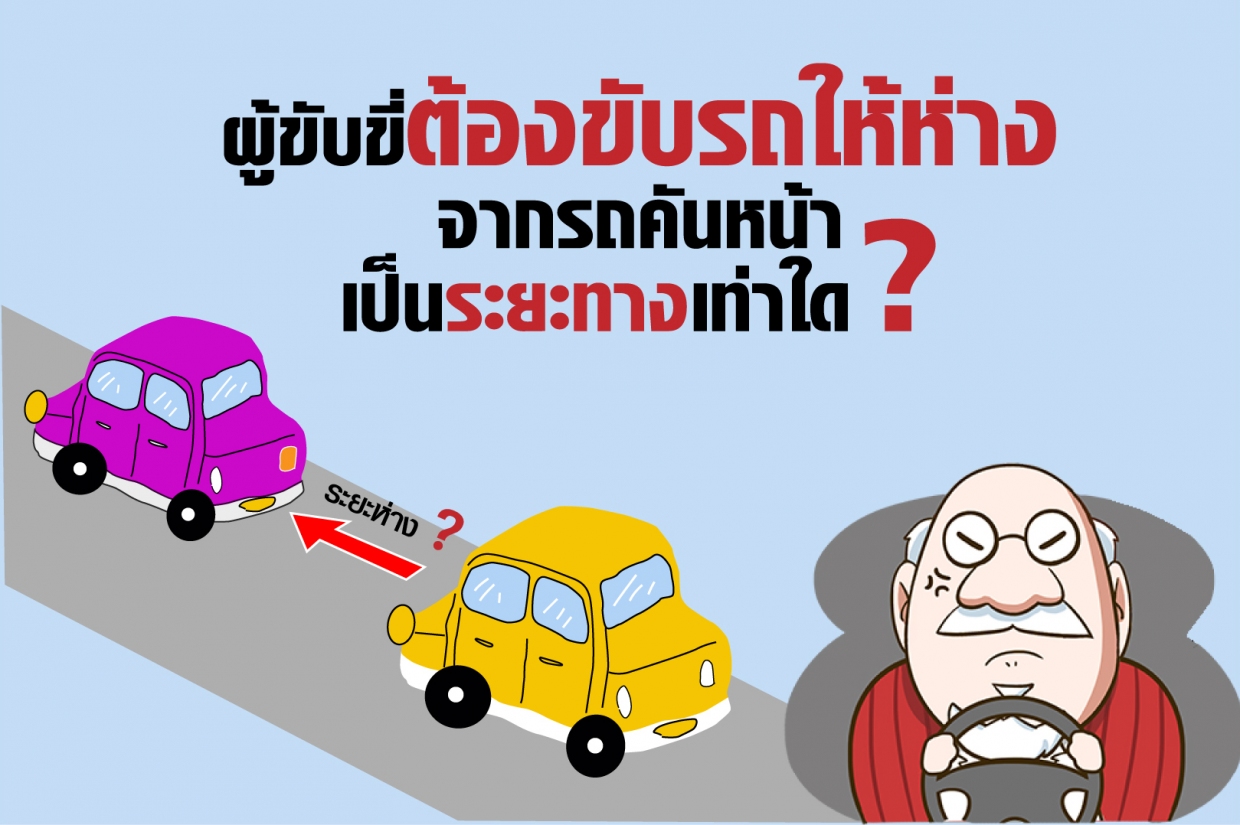
To drive safely, you must maintain a sufficient distance. The most important thing is to maintain an appropriate distance from the car in front. Let's see why it's necessary to maintain an appropriate distance? The simple answer is because we cannot start braking at the same time as the car in front, and we might not brake as effectively as the car in front either. As soon as the car in front brakes, its speed will immediately decrease, but our car will still be moving at a constant speed, causing it to rush towards the car in front. While our eyes start to see the brake lights, the brain perceives and decides that we must brake, otherwise, we will rear-end that car. The brain sends commands to the leg muscles, and it still takes time to lift the foot from the accelerator to the brake pedal, then extend the leg to press the brake pedal. Once pressed, it takes a certain amount of time for the brake pads to be compressed against the brake disc and for braking force to begin. During all this time, our car will constantly drive closer to the rear of the car in front. If the time we have prepared, which is the distance we maintain, is less than what is needed, then you'll be calling staff from the insurance company, and it might also cause inconvenience to hundreds of people sharing the road. It gets even worse if an accident occurs during heavy rain.
According to international standards for maximum safety, the distance from the rear of the car in front is set at half the speed in km/h, using meters as the unit of length. For example, when driving behind a car at 100 km/h, a distance of 50 meters should be maintained. However, in traffic conditions and driving behavior, it is reduced by another half (which is still good), and if circumstances force it, it can be reduced to 1/4, which is actually not a safe distance, but still better than the 1/10 currently used. Therefore, from the original example, the distance that should be maintained at a speed of 100 km/h is approximately 50 meters to 30 meters.
So, let's see how to drive safely and not obstruct others?
To drive safely, drivers should maintain a reasonable distance from the car in front, as accidents can happen at any time, especially in unusual weather conditions. Maintaining a distance from the car in front will always allow us to prepare for unexpected events and emergencies.
However, if you drive too far back, cars behind will try to overtake you, unknowingly increasing the chance of accidents for others. This is because over 80% of road accidents are caused by incorrect road usage behavior, and over 11% come from passing on the left. The reason the law prohibits passing on the left is that if a proper distance from the car in front is maintained, it wouldn't have much effect as both left and right visibility would be clear. But if you drive too close to the car in front, visibility on the left side will be significantly reduced. And if a driver squeezes into the left lane to accelerate and overtake, it could cause a collision with a parked car. For this reason, passing on the right is safer. Furthermore, passing on the left is also a violation of the Land Traffic Act B.E. 2522 (1979), Chapter 2, Section 45, which states that drivers are prohibited from overtaking other vehicles on the left.
Seeing this, why are some still driving with excessive distance? Let's look at examples
-Some people think they are driving at the legal speed limit and therefore self-righteously believe they are following the law, while those driving faster are breaking it. This can cause trouble for people who are genuinely in urgent situations.
-Some people don't look in their rearview mirror at all because they adjust their seat too close to the steering wheel, making it inconvenient to see the rearview mirror, so they choose not to look (just like that!). The solution for smaller drivers, if they are afraid of not having a clear view of the front of the car, is to adjust the seat higher and the steering wheel level appropriately to get a full view of the traffic around the car.
[Driving too close to the steering wheel, what's wrong with it? > Click here ]
We have a solution...
- If we are slow drivers, the simple solution is to speed up to match the car in front, maintaining an adequate distance. But if it feels too fast, just switch to the left lane. That's all.
- If driving behind a slow car, you can flash your high beams or gently honk the horn politely. But if they don't move, it's better to change lanes ourselves, and avoid losing our temper.
Is driving slow wrong too?
- Driving slowly and obstructing the road is not only a matter of driver awareness but also a violation of the Land Traffic Act. Section 35 states that vehicles traveling slowly or at a speed lower than other vehicles must be driven as close to the left edge of the road as practicable.
What if the left lane is very bumpy?
Everyone loves their car! Just drive at a moderate speed in the right lane, not too slowly. Constantly check your rearview mirror. If a car behind you is driving faster, signal and move slightly to the left to let them pass first. This point also requires discretion, as the law clearly states that the right lane can only be used when driving faster than the left or when overtaking. Therefore, driving continuously in the right lane is illegal. Don't forget that roads are meant to be shared; there might be people who are genuinely in a hurry or distressed.
Let's watch this clip for guidance on using vehicles and roads >>>